How to Stop Watching Porn
Start changing pornography use with a practical plan for urges, routines, and setbacks. Learn when counseling can help and how to choose support that fits your goals.


Battling addiction & ready for help?
Start Changing Your Porn Use Today
If you have promised yourself you would stop and then returned to pornography, another promise may feel discouraging. You can start with a specific plan and ask for help while you build it. You do not need to wait for a crisis or prove that you have an addiction before discussing behavior that concerns you.[1]
Choose one situation to work on first. Perhaps viewing repeatedly keeps you awake, interrupts work, or breaks an agreement with your partner. Write down what you want to do differently in that situation. A goal such as “I want to stop taking my phone to bed” gives you something concrete to try and review.
Researchers use problematic pornography use, or PPU, for pornography use associated with difficulty controlling behavior and significant problems. Some people meet criteria for compulsive sexual behavior disorder; others need help with a habit, relationship conflict, or distress about values. A professional assessment helps distinguish these concerns.[1]
- Make the plan specific. Identify a situation linked with use, choose a response, and review what happened. These are skills commonly addressed in cognitive behavioral approaches.[2]
- Treatment can help. Research supports promising benefits from psychotherapy, including CBT and acceptance and commitment therapy, while study limitations remain.[3]
- Choose your goal with care. Abstinence or another behavior goal should reflect your concerns and assessment rather than a universal rule.[1]
- Measure more than a streak. Control, distress, relationships, and the life you want to return to are relevant outcomes too.[1]
What to Do When You Want to Watch Porn Right Now
Start by creating room for a choice. You can close the tab, put down the device, and move to another activity or place. These are practical options to try, not a requirement to make an urge disappear. There is no established rule that every pornography urge peaks and ends within a particular number of minutes.[2]
Acceptance-based therapy teaches a useful distinction: having an urge and acting on it are different experiences. You can notice a thought or feeling while choosing an action that fits your goal. You do not have to win an argument with every thought before taking that action.[2][4]
| If this is happening | A response to try | What to notice afterward |
|---|---|---|
| You have opened the site automatically | Close it and move the device out of reach while you decide what to do next. | What was happening just before you opened it? |
| You are using pornography to avoid a difficult feeling | Name the feeling and choose a response to that need: rest, a conversation, a walk, or another activity you find useful. | Did the original need receive attention? |
| You are bargaining with yourself about watching longer | Return to the specific goal you chose, rather than renegotiating the entire plan in that moment. | Was the goal clear enough to follow? |
| The urge continues | Try another planned activity or contact support you have agreed on. | What made the situation difficult, and what could you change? |
| You watched despite your plan | Stop the episode when you can, note what happened, and decide on one next step. | What does the plan need, rather than what is wrong with you? |
A timer can be a reminder to check in with yourself if you find it useful. It is not a countdown to guaranteed relief. If urges repeatedly interfere with your day, bring that pattern to a therapist instead of assuming you failed because a technique did not work immediately.[1][2]
Build a Plan to Change Your Porn Use
A practical plan connects common treatment themes with actions you can discuss with a provider. You do not need to implement everything at once. Start where the problem is most concrete, and use what you learn to decide what to add next.[1][2]
Describe Your Pattern of Use
For a few episodes, note the time, situation, feeling, behavior, and consequence. “After an argument, I watched until after midnight and missed sleep” is more useful than “I have no discipline.” It identifies several possible places to intervene and gives a clinician information about the function of the behavior.[2]
Emotion-regulation difficulties and loneliness have been associated with problematic use. That does not mean everyone watches for the same reason. Your notes may show that a particular routine, mood, or relationship situation matters more than you expected.[5]
Make the Environment Fit the Goal
Consider the device, setting, and time where you most often lose track of your plan. You might charge your phone outside the bedroom, remove saved shortcuts, or choose a different evening routine. Treat each change as an experiment: is it useful and workable for you?
Filters and pornography recovery apps may add friction, but a product is not a complete treatment plan. Before using monitoring features, check what information is collected and who can see it. You do not have to share passwords or detailed browsing records with another person as a condition of asking for help.
Plan for the Need Behind the Habit
If problematic pornography use has become your main response to stress or loneliness, removing it leaves a question: what will you do with that feeling? Treatment can address coping and other mental health concerns alongside the behavior. Choose alternatives that are realistic in the situation where you will need them.[1][2]
A late-night plan might include ending work earlier, contacting a friend before bed, or bringing unresolved anxiety to an appointment. These examples are starting points, not treatments proven to work for everyone. Review whether the alternative actually addresses the need rather than merely filling time.
Choose Support You Feel Safe Using
Support can mean a qualified therapist, a suitable group, or a trusted person willing to help in a way you both understand. An analysis of 104 online abstinence journals described participants using behavioral strategies and social support. It provides insight into their experiences, not proof that disclosure or joining a particular community guarantees success.[6]
Be specific about what you are requesting: “Could I check in after a difficult evening?” or “Can you help me find a therapist?” You can choose how much to share. A partner may need their own support and should not automatically become responsible for monitoring your behavior.[1]
Review What Worked and What Needs to Change
Choose a time to look back at the plan. Did you keep the commitment you chose? Which situations remained difficult? Did lost sleep, distress, or relationship problems improve? Treatment includes reviewing goals and responses, rather than using viewing frequency as the only measure of success.[1][2]
If the same problem keeps returning, that is a reason to adjust the plan or seek more support. It is not proof that you cannot change. Assess porn addiction recovery by looking at progress over time.
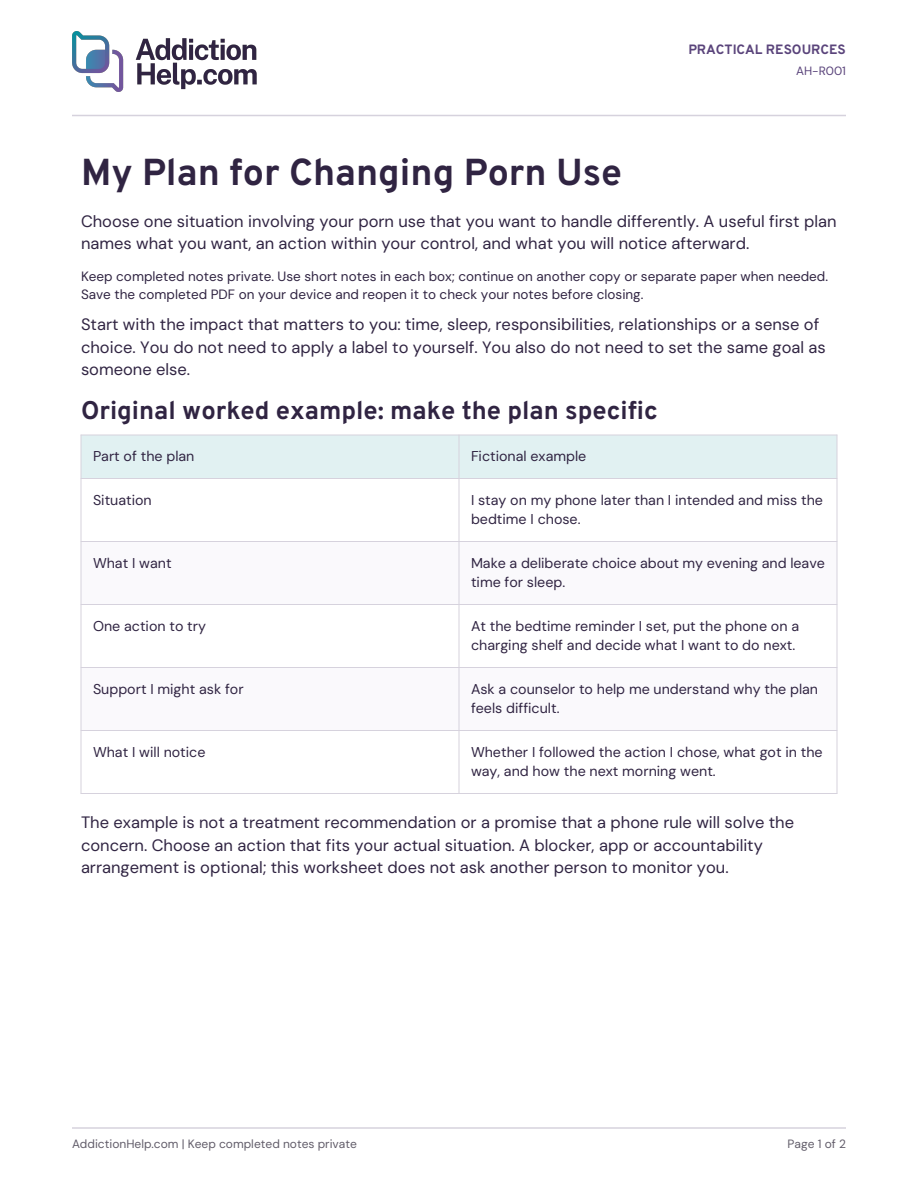
AddictionHelp.com · Practical resources
My Plan for Changing Porn Use
Use a worked example to choose one change in your own porn use, identify support, and decide what to review afterward.
2-page fillable PDF · Free · No signup
Why Stopping Porn Can Be Difficult
A decision can be sincere and still leave you without a response to the next difficult situation. Research examines attention, learning, craving, and control to understand problematic use. These findings can inform treatment without reducing you to a malfunctioning brain.[1][7]
A review of 21 experimental studies found associations with attention to sexual cues, response inhibition, working memory, and decision-making. These are group-level findings on research tasks, not proof that everyone with a pornography concern has impaired thinking in everyday life.[7]
A daily-life study involving 118 people with gaming or pornography-use concerns, including 44 in the pornography group, linked craving and reported inhibitory control with moments of impaired control.[8] It supports paying attention to situations and experiences around use. It does not establish that a tired evening inevitably ends in viewing.[8]
In an imaging study, men seeking treatment showed a stronger response than controls to cues predicting erotic images, but not to the images themselves. This supports a possible role for anticipation. It does not show that your brain always values the promise more than the reward, or that changing a cue alone will resolve the problem.[9]
If you are unsure whether the pattern is problematic, review the warning signs and discuss your examples with a clinician. A pornography self-check can help organize concerns, but it cannot provide a diagnosis.
Which Treatments Can Help With Porn Use?
Psychotherapy can reduce problematic pornography use and related symptoms. A 2025 meta-analysis pooled 20 studies with 2,021 participants and found benefits, including reductions in problematic use and sexual compulsivity.[3] The authors also identified high risk of bias and limited diversity. The findings are encouraging without establishing a guaranteed result for an individual.[3]
Cognitive Behavioral Therapy
Cognitive behavioral therapy, or CBT, explores connections among situations, thoughts, feelings, and behavior. Work may include identifying triggers, practicing coping skills, examining beliefs, and planning for setbacks. Ask what you would practice between appointments and how the therapist would decide whether it is helping.[2]
A 2026 scoping review identified 11 CBT-based intervention studies published between 2019 and 2024. The studies reported improvements but used different methods and had limitations, including dropout. CBT is a reasonable approach to ask about; the review does not establish one standardized program that is best for everyone.[10]
Acceptance and Commitment Therapy
Acceptance and commitment therapy, or ACT, emphasizes responding flexibly to thoughts and feelings while choosing actions aligned with values. An unwanted thought does not have to disappear before you do something meaningful. Treatment can help you practice that distinction in situations where you feel pulled toward pornography.[2]
In a randomized trial of 28 adult men, viewing decreased by 93% in the ACT group compared with 21% in a waitlist group after 12 sessions.[4] Almost all participants belonged to the same religious community. That figure describes how much viewing decreased, not a cure rate, and the small sample limits how widely the result can be applied.[4]
Mindfulness and Other Treatment Components
Mindfulness, motivation, and relapse-prevention skills may be included within a broader treatment plan. The evidence is stronger for studying complete interventions than for promising that one isolated skill will work on demand. Ask how a proposed exercise relates to your goal and what to do if it is not helping.[2][10]
Brain stimulation is being studied experimentally. In a small laboratory study, participants practiced cognitive strategies to regulate craving, and stimulation affected regulation under study conditions. This does not establish brain stimulation as a routine or do-it-yourself treatment for problematic pornography use.[11]
Online Programs
A randomized trial of the six-week Hands-off self-help program found improvements among people who completed follow-up. However, dropout was very high: 89.4% in the intervention group and 44.7% in the waitlist group.[12] That limits what the study tells us about everyone who begins such a program.[12]
When comparing online options, ask who developed the program, what evidence supports it, how sensitive information is stored, whether a professional is available, and what happens if your concerns worsen. A program may be one part of care rather than the entire plan.
Do You Need to Quit Porn Completely?
Abstinence can be a personally chosen goal, and some people prefer a clear boundary. Others may work toward reducing use or changing a harmful pattern. The goal should fit your concerns, values, and assessment. A clinician should not impose a universal rule that all pornography use or all sexual expression must stop.[1]
Consider what each option means in practice. What behavior are you trying to change? How will you respond when the plan is difficult? What outcome would show that the approach is helping? If repeated attempts at a particular goal are not working, discuss both the goal and the support available.[1]
What About Rebooting or a 90-Day Reset?
Online communities use “rebooting” for a period without pornography, sometimes with additional restrictions. Participants in an analysis of 104 male abstinence journals described challenges, perceived benefits, and coping strategies. These accounts do not prove that abstinence resets the brain or that a specific number of days is medically necessary.[6]
Another qualitative study described how rigid streak-and-relapse language could contribute to distress. That does not make every abstinence goal harmful. It is a reason to notice whether counting days supports your goals or turns one episode into a verdict that everything is lost.[13]
There is no established universal brain-reset deadline in the treatment evidence. For more on the approach and its claims, see NoFap and pornography abstinence. For discomfort when changing use, review reported pornography withdrawal symptoms without assuming that every symptom has the same cause.[2]
What if Pornography Conflicts With Your Values?
You can want to change your behavior because of your beliefs and still deserve respectful, nonjudgmental help. Research describes moral incongruence as a mismatch between pornography use and personal values; it is associated with distress and a stronger sense of being addicted.[14]
A study of pornography users in a Polish national sample found contributions from both behavioral dysregulation and moral incongruence. The lesson is to assess both, rather than assume that guilt explains every problem or that any guilt proves addiction.[15]
A clinician can help you discuss behavior, values, and self-judgment together. Treatment should not require abandoning your beliefs, nor should it label sexuality itself as a disease. Persistent loss of control and distress based entirely on moral disapproval require different clinical consideration.[1]
What to Do After a Porn-Use Setback
If you watch after deciding not to, focus first on what happens next. You can end the episode, return to the plan, and address any immediate consequence. A setback does not erase the skills you practiced or remove your ability to ask for help. Reviewing difficult situations is part of relapse-prevention work.[2]
Try a brief review:
- Describe what happened. Note the situation without turning it into a judgment about your character.
- Identify the gap. Was the plan vague, unavailable, or poorly matched to the situation?
- Choose one adjustment. Make it specific enough to try next time.
- Address consequences. A missed responsibility or broken agreement still deserves attention.
- Reconnect with support. Contact your provider if the pattern or distress is worsening.
You do not need to conduct a perfect analysis before moving forward. Bring your notes to care. If tracking itself becomes a source of preoccupation or self-punishment, discuss a different way to review progress.[1]
When to Seek Help With Porn Use
Consider porn addiction counseling when repeated efforts have not worked, use is interfering with responsibilities or relationships, or distress is difficult to manage. Assessment can also identify depression, anxiety, sexual concerns, medication effects, or other issues needing attention alongside the behavior.[1]
A useful first message can be simple: “I am having trouble changing my pornography use, and I want help understanding the pattern.” Ask about the provider’s experience, approach, fees, privacy, and how goals are decided. Choose among help options with those questions in mind.
If you are thinking about suicide or are in emotional distress, call or text 988 in the United States. Call 911 for immediate danger.[16]
Find Support for Changing Your Porn Use
You do not need to complete every step today. Choose the problem you want help with first, then explore porn addiction resources for support options and questions to bring to care. A practical plan can begin with one change and one conversation.
Frequently asked questions
Can I Stop Watching Porn on My Own?
Some people choose self-directed changes, and online interventions show promising findings. Studies do not establish which approach will work for every person. If repeated attempts fail, distress worsens, or use interferes with life, a professional assessment can help you choose a different level of support.[12][1]
How Long Does It Take to Stop Watching Porn?
Will a Porn Blocker Solve the Problem?
A blocker may add a practical barrier, but it does not by itself address every reason for use, relationship concern, or mental health need. Consider it one possible tool within a plan, and review its privacy settings and whether it is actually useful to you.[1]
Do I Have to Stop Masturbating Too?
There is no universal requirement to stop all sexual expression. Assessment should identify the behavior causing problems and support sexual well-being. Discuss your goals with a clinician rather than assuming that a rule from an online abstinence community is a medical requirement.[1]
Does One Setback Mean Treatment Has Failed?
A difficult episode is a reason to review the plan, its fit, and the support available. Treatment approaches include work on recurring situations and relapse prevention. Address any consequences while deciding what needs to change next.[2]
What if I Am Too Embarrassed to Tell a Therapist?
You can start with a brief description such as “I am struggling with my pornography use.” You do not need to prepare a diagnosis or describe every detail in the first message. Ask how the therapist handles privacy, values, and sexual-health concerns before deciding whether the fit feels right.[1][17]
Get Treatment Help
If you or someone you love is struggling with addiction, getting help is just a phone call away, or consider trying therapy online with BetterHelp.
Exclusive offer: 20% Off BetterHelp*Following links to the BetterHelp website may earn us a commission that helps us manage and maintain AddictionHelp.com. *Get 20% off your first month of BetterHelp. Offer valid for new BetterHelp users only. Offer cannot be combined with insurance.

- Fact-Checked
- Editor